



 Contact


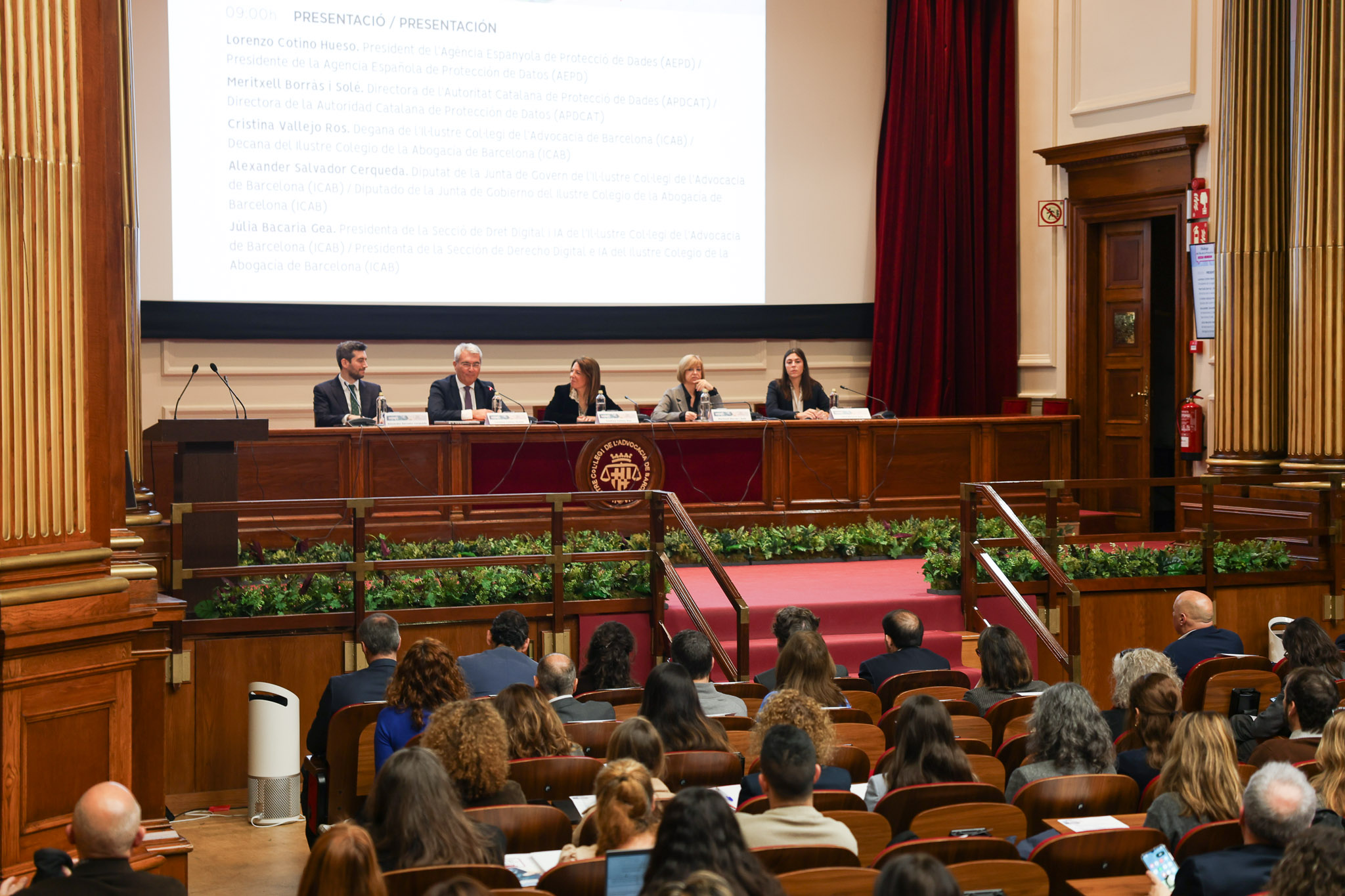
The Catalan Data Protection Authority (APDCAT), the Spanish Data Protection Agency (AEPD), and the Barcelona Bar Association (ICAB) – through its Section of Digital Law and Artificial Intelligence – brought together more than twenty experts in the field of AI and data protection at the ICAB headquarters as part of the “Privacy Day Dialogues,” with the aim of fostering legal, institutional, and technical debate on cybersecurity, data breaches, the regulation of artificial intelligence, and the role of privacy professionals. The event, held in the ICAB Assembly Hall on International Data Protection Day, was attended by more than 300 participants.
The ‘Privacy Day Dialogues’ were opened by Lorenzo Cotino, President of the AEPD; Meritxell Borràs, Director of the APDCAT; Cristina Vallejo, Dean of the ICAB; Alexander Salvador, member of the ICAB Governing Board, and Júlia Bacaria, President of the ICAB Section of Digital Law and AI.
During his speech, the President of the AEPD, Lorenzo Cotino, framed the celebration of this day in a historic moment, with artificial intelligence as the central core of a change of era. In this regard, he stated that the Agency’s commitment to the use of AI is clear, but always in compliance with regulations: “Privacy acts as an instrumental right for the protection of the whole set of fundamental rights in the digital sphere, and this is equally applicable in the context of AI.” He added that the Agency has made public its internal policy on the use of AI with a clear message: AI must be used, but in accordance with the Strategic Plan and with a commitment to responsible innovation. At the institutional level, the President of the AEPD highlighted the importance of cooperation with regional data protection authorities, the Spanish Agency for the Supervision of Artificial Intelligence (AESIA), and the Secretary of State for Artificial Intelligence.
For her part, the Director of the APDCAT, Meritxell Borràs i Solé, emphasized that data protection is not yet an internationally achieved milestone and that there are those who believe that authorities, professionals, and data protection in general are an obstacle to innovation. She also regretted that some consider fundamental rights to be an unnecessary or inconvenient limit to their political project. Nevertheless, she expressed optimism about the consolidation of the right to data protection, given that the current technological ecosystem grants it key importance and regulations give it a more prominent role.
The Dean of the ICAB, Cristina Vallejo, highlighted the value of hosting, for the first time at the Barcelona Bar Association headquarters, both the President of the AEPD and the Director of the APDCAT, and the opportunity this represents to move forward in data protection regulation, taking into account the speed of technological change and the emergence of issues related to citizens privacy and honour.
Cross-cutting analysis through four roundtable discussions
The program included four roundtables. The first, devoted to cybersecurity, data breaches, and data protection, featured Francisco Pérez Bes, Deputy to the Presidency of the Spanish Data Protection Agency; Genís Margarit, professor at Pompeu Fabra University; and Laura Caballero, Director of the Catalan Cybersecurity Agency, moderated by David de Falguera, Vice President of the ICAB Section of Digital Law and AI. Pérez Bes highlighted the convergence of cybersecurity and data protection in organizational resilience, with Data Protection Officers as a key element in preventing and managing data breaches, which have become genuine business and corporate risks with a significant impact on people’s rights.
The second roundtable addressed the challenges of data protection and artificial intelligence, with contributions from Xavier Urios, Head of the Legal Advisory Office of the Catalan Data Protection Authority (APDCAT); Aleida Alcaide, Director General for Artificial Intelligence at the Ministry for Digital Transformation and the Civil Service; Lorenzo Cotino, President of the Spanish Data Protection Agency (AEPD); and Albert Tort, Secretary for Telecommunications and Digital Transformation of the Government of Catalonia. It was moderated by Paula Martín, member of the ICAB Section of Digital Law and AI.
The analysis of new regulations and professional opportunities in the field of privacy was made possible thanks to presentations by Meritxell Borràs, Director of the Catalan Data Protection Authority (APDCAT); Eduard Chaveli, President of the IT Law Section of the Valencia Bar Association (ICAV) and Vice President of the AI Community of the Spanish Association for Quality (AEC); and Manel Carpio, AI expert. This third roundtable was moderated by David Molina, member of the ICAB Section of Digital Law and AI.
The fourth and final roundtable of the ‘Privacy Day Dialogues’ served to initiate a debate and reflection on the need to move toward a statute for privacy professionals. Participants included Rosa Parrilla, Data Protection Officer of the Department of the Presidency of the Government of Catalonia and member of the ‘DPD en xarxa’ community; Miguel Recio, President of the Spanish Professional Privacy Association (APEPIA); Carlos A. Saiz, Vice President of ISMS Forum; and Eduardo López Roman, Data Protection Officer of the ICAB. The session was moderated by Roger Vilanova, Director of Privacy, Intellectual Property, and New Technologies at a law firm.
This edition of the ‘Privacy Day Dialogues’ was closed by Lorenzo Cotino, President of the Spanish Data Protection Agency (AEPD); Meritxell Borràs, Director of the Catalan Data Protection Authority (APDCAT); Alexander Salvador, member of the Governing Board of the Barcelona Bar Association (ICAB); and Júlia Bacaria, President of the ICAB Section of Digital Law and AI.
It should be noted that Alexander Salvador emphasized that personal data have become a strategic asset driving innovation and business models in our society. For this reason, he considers it “essential to promote spaces for analysis and reflection such as the ‘Dialogues’ held at the ICAB headquarters, in order to move forward jointly among public administrations, supervisory authorities, and the legal profession”, and warned that “given the current high regulatory demands in this field, any legal uncertainty may generate adverse effects both for the business sector and for individual freedoms”.
For her part, Júlia Bacaria stated that regulations in the digital and privacy fields face the constant challenge of adapting to innovations that advance at a much faster pace than that of lawmakers, including AI, creating tensions between the need to foster economic development and the need to protect rights. She therefore stressed that the ‘Privacy Dialogues’ held at the Barcelona Bar Association have made it possible, through thorough analysis, to help clarify criteria, anticipate risks, reduce uncertainty, and promote a harmonized interpretation of the regulatory framework, strengthening a culture of compliance that protects citizens.
The celebration of this new edition of the ‘Privacy Day Dialogues’ consolidates the event as a meeting point for institutions, the legal profession, public administrations, and specialized professionals, with the aim of reinforcing respect for data protection as a fundamental right in a constantly evolving digital environment and asserting its leading role in an increasingly technological society in which personal data play a decisive role in the economy.
This conclusion was highlighted during the conference ‘Privacy Day Dialogues’, held at the headquarters of the Barcelona Bar Association, on ‘International Data Protection Day’, which is commemorated every January 28