


 Contact


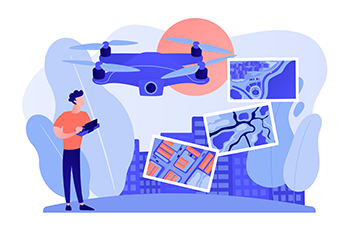
Drones have become popular in recent years for multiple purposes, including:
- Security and surveillance
- Filming films or documentaries
- Cartography
- Recreational use of images
Highlights
- Data protection regulations apply if the images allow people to be identified and are not used strictly for domestic purposes. In the latter case, data protection regulations do not apply.
- This implies that the data cannot be used publicly or socially, such as by incorporating the images into social networks, unless the collection of data from third parties is incidental.
- As for third-party data, it can be faces, voices, license plates, private spaces and anything that identifies someone.
- Apart from data protection regulations, it is necessary to check whether authorization is required for its use in accordance with the specific regulations on drone flights.
- In short, in any case, the right to privacy, intimacy and honor of people must be respected.
- In the event that personal data is processed, a risk analysis will need to be carried out and, depending on the processing, a data protection impact assessment.
If drones are used to monitor the security of a certain event, the following aspects must be taken into account:
- A visible information poster must be placed so that people are aware of it.
- The processor must be specified.
- If images with recognizable spaces and people are to be published on the internet and networks, their consent must be obtained, provided that, as we have indicated above, the capture of the image is not incidental.
In the case of video surveillance by the Security Forces and Bodies, their specific regulations apply.
- Record primarily in spaces and times that are not crowded.
- Take images at a fairly high altitude, or with a resolution that does not clearly identify people.
- Eliminate, pixelate or anonymize the parts that show third parties, whenever possible, since the data processed must be minimal.